




If you’re considering participating in the March 2026 Databricks tender offer, one question matters more than almost anything else:
How much cash will I actually walk away with after taxes?
To answer that, you need to separate two different tax events:
- The tax you paid when your RSUs vested
- The tax you’ll owe if you sell shares in the tender
This article focuses on the second one, capital gains tax, and walks through how to calculate your net proceeds step-by-step.
If you haven’t read our overview of whether to participate and how many shares to sell, start here.
Here, we focus strictly on the mechanics.
First, Separate RSU Income From Capital Gains
When your RSUs vest, the value of those shares is taxed as ordinary income. The company withholds federal tax, usually at 22% unless you elect 37%.

That tax event already happened at vesting.
When you sell shares in the tender offer, you’re triggering a different tax event: capital gains tax.
The gain is based on the difference between:
- The tender offer price
- And the issue price (the value when the shares were originally delivered to you)
Understanding that distinction is critical. The tender does not re-tax the full value of your RSUs. It only taxes the gain since issuance.
Step 1: Understand What a “Lot” Is
Your shares are grouped into “lots” in your equity platform.
Each lot represents shares issued on a specific date at a specific issue price.
Different lots may have:
- Different issue prices
- Different holding periods
- Different tax treatment
That’s why you can’t treat all your shares as one pool. Each lot needs to be evaluated separately.
Step 2: Calculate the Total Unrealized Gain for That Lot
Let’s use this example as an illustration.
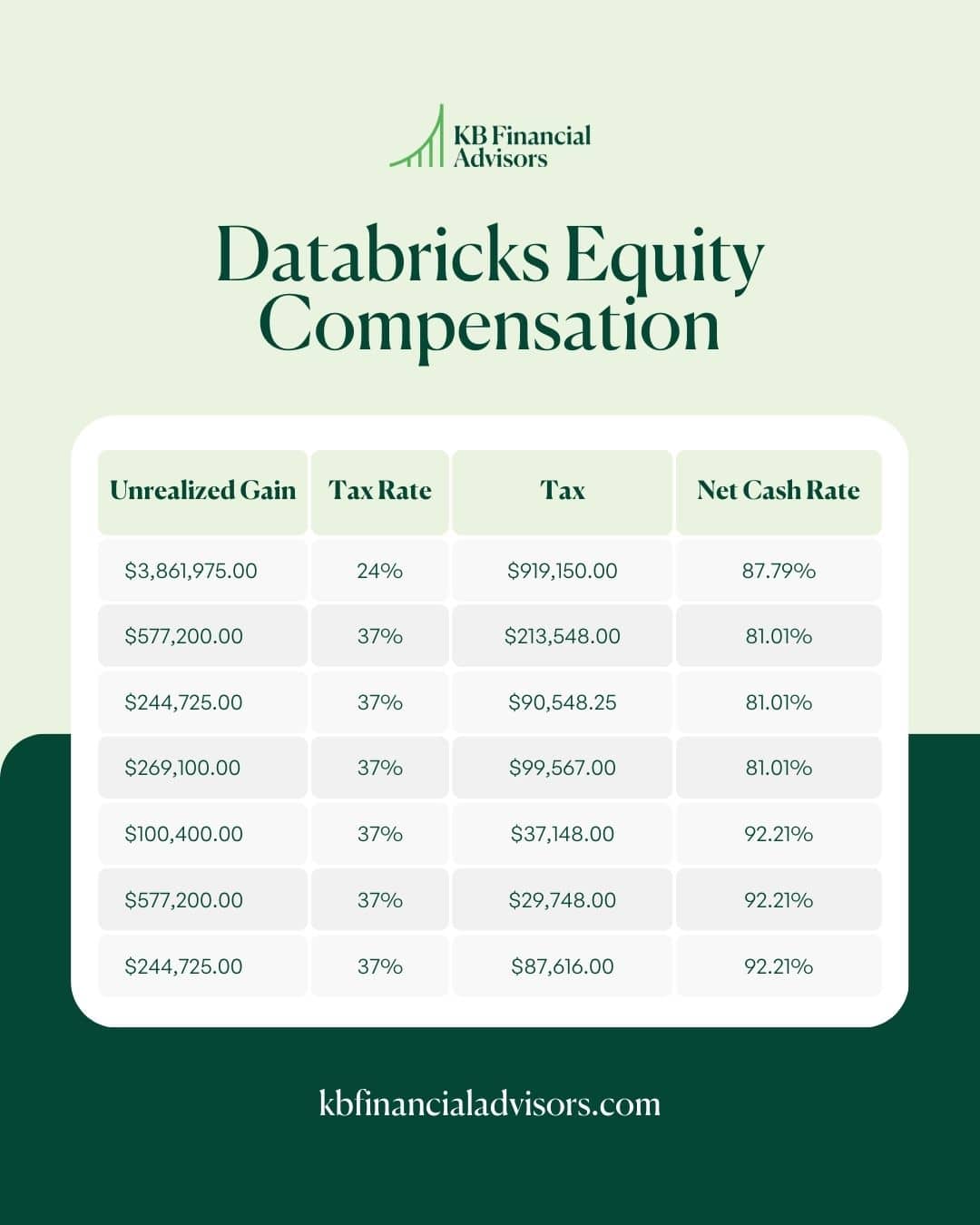
For each lot, start by calculating how much gain is embedded in it.
First:
Unrealized Gain per Share = Tender Offer Price – Issue Price
Then multiply by the number of shares in that lot to find the Total Unrealized Gain for the lot.
Total Unrealized Gain (for the lot) = Unrealized Gain per Share × Number of Shares
This gives you the total amount that will potentially be taxed if you sell that lot in the tender. You are not taxed on the full sale amount, only on this gain.
Step 3: Determine Whether That Lot Is Short-Term or Long-Term
Next, determine the tax rate that applies to that specific lot.
- If the shares were issued less than one year and one day before the sale date, the gain is typically short-term.
- If held longer than one year and one day, it is generally long-term.
For planning purposes, high-income earners often assume:
- 37% federal tax on short-term gains
- 23.8% federal tax on long-term gains (20% capital gains + 3.8% net investment income tax)
Each lot may have a different holding period, which is why this step matters.
Step 4: Estimate the Tax for That Lot
Now apply the tax rate to the total gain for that lot:
Estimated Tax = Total Unrealized Gain × Tax Rate
This tells you how much federal tax would be owed if you sold that lot in the tender offer. Again, notice that the tax applies only to the gain, not to the full sale proceeds.
Step 5: Calculate the Gross Proceeds for That Lot
Next, calculate how much cash the sale would generate before taxes:
Gross Proceeds = Number of Shares in the Lot × Tender Offer Price
This is the total dollar amount you would receive if you sold that entire lot.
Step 6: Calculate Your Net Cash and Net Cash Rate
Now subtract the estimated tax from the gross proceeds:
Net Cash = Gross Proceeds – Estimated Tax
This is the amount you would actually keep after the federal capital gains tax.
To compare lots more easily, convert that into a percentage:
Net Cash Rate (%) = Net Cash ÷ Gross Proceeds
This tells you what percentage of the sale proceeds you keep after tax.
When you calculate this across multiple lots, you may find something surprising:
A short-term lot with a smaller embedded gain can sometimes produce a higher net cash rate than a long-term lot with a large embedded gain.
That’s exactly why it’s important to run the numbers lot by lot instead of assuming the lowest tax rate always produces the best outcome.
Why the Tax Rate Alone Can Be Misleading
Many employees assume that they should sell long-term shares first because the tax rate is lower.
That’s sometimes true, but not always. What matters isn’t just the rate. It’s the size of the embedded gain.
A short-term lot with a small unrealized gain can sometimes produce a higher net cash rate than a long-term lot with a large embedded gain. In other words, even though the tax rate is higher, the total tax paid may be lower relative to the sale proceeds.
That’s why calculating the net cash rate lot-by-lot is important.
However, tax efficiency alone shouldn’t drive the entire decision.
Before optimizing which lots to sell, you should first decide:
- Whether you want to reduce your Databricks exposure
- How much concentration risk are you comfortable keeping
- How much liquidity do you want to generate
Only after you’ve decided how many shares to sell does it make sense to prioritize lots with higher net cash rates.
If you’d like a broader framework for thinking through participation, concentration risk, and how much to sell, we discuss those strategic considerations in our other article on the Databricks 2026 tender offer decision.
Final Thoughts
The Databricks March 2026 tender offer is not just a transaction. It’s a calculation problem layered on top of a broader planning decision.
Without running the numbers lot by lot, it’s easy to assume you understand the outcome when you don’t. Two employees with similar share counts can walk away with materially different after-tax proceeds depending on issue dates, embedded gains, and holding periods.
And capital gains from the tender don’t exist in isolation. They affect your total 2026 tax liability, your withholding sufficiency, and whether estimated payments are required.
Before submitting your election, you should know:
- Your projected gross proceeds
- Your estimated federal and state tax
- Your net cash by lot
- Whether additional tax payments will be required this year
If you want a lot-by-lot analysis and a coordinated 2026 tax projection before the March deadline, KB Financial Advisors works with tech employees navigating complex equity events like this.
We can help you quantify the impact before you make an irreversible decision. If you need a sounding board before making a decision, book a consultation with us today.